
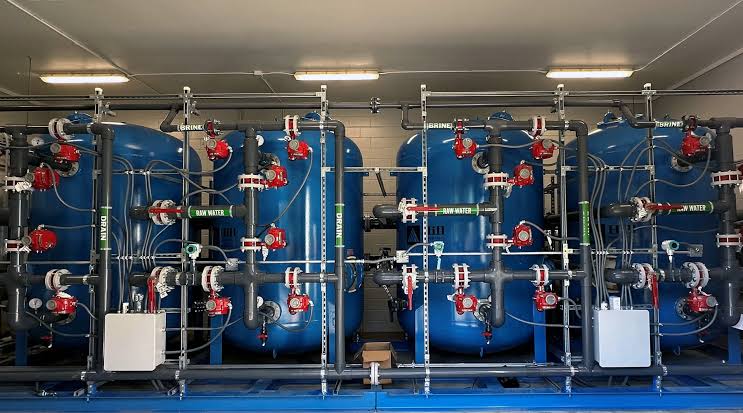
Water plays a surprisingly important role in keeping a business running. In a home, a little mineral buildup might mean scrubbing the shower more often. In a restaurant, hotel, laundry facility, office building, or manufacturing plant, the consequences can be much bigger.
Commercial properties often use large amounts of water every day, sometimes around the clock. When that water is hard, minerals can gradually collect inside plumbing, heaters, boilers, dishwashers, and other equipment. What starts as a minor nuisance can eventually become an expensive maintenance problem.
The good news is that water hardness can be managed. The key is understanding how it affects a commercial property and choosing equipment that can keep up with real-world demand.
What Makes Commercial Water Different?
The basic chemistry of hard water doesn’t change simply because the water is being used by a business. Calcium and magnesium are still the primary minerals responsible for hardness.
What does change is the volume of water being used and the importance of consistent performance.
A household might use water mainly in the morning and evening. A restaurant may need it continuously for cooking, cleaning, beverages, ice production, and dishwashing. A hotel has guests using showers and sinks throughout the day. A laundromat can have washing machines operating for hours.
These businesses have high-capacity demands that require treatment equipment designed accordingly. A system that works perfectly for a family of four may quickly become overwhelmed in a busy commercial environment.
The Trouble With Scale Buildup
Hard water becomes particularly frustrating when minerals begin collecting on surfaces and inside equipment.
The white residue around a faucet is the easy-to-see version. The more concerning buildup happens where you can’t easily see it—inside pipes, water heaters, heating elements, boilers, and commercial appliances.
Over time, scale buildup can restrict water flow and reduce the efficiency of equipment that heats water. In a business environment, that can mean more frequent cleaning, higher maintenance costs, and equipment that doesn’t perform as efficiently as it should.
For a restaurant, even a small reduction in equipment performance can become a daily headache. Nobody wants a dishwasher taking longer than it should during the busiest part of dinner service.
Why Commercial Water Softeners Can Help
Water softening is designed specifically to address hardness caused by calcium and magnesium. For businesses dealing with significant hard-water problems, commercial water softeners can provide a practical way to reduce those minerals before the water reaches critical equipment and fixtures.
The result isn’t simply water that feels different. Softened water can help reduce mineral deposits throughout the plumbing system and water-using equipment.
That may make routine cleaning easier and potentially reduce the amount of scale-related maintenance required.
Of course, a softener isn’t a universal water-treatment solution. It doesn’t remove every possible contaminant, and it shouldn’t be selected without understanding the property’s water conditions.
Start With Water Testing
Before investing in commercial treatment equipment, testing the water is one of the most sensible things a business can do.
A water test can help identify hardness levels along with other characteristics that may influence treatment choices. Depending on the property, testing may also examine pH, sediment, chlorine, dissolved solids, or other concerns.
This information helps determine whether softening is actually necessary and, if it is, what type and capacity of system might be appropriate.
It’s better to spend a little time understanding the water than to purchase equipment based on a guess. A treatment system should solve a measurable problem, not simply look impressive in a mechanical room.
Matching Equipment to Daily Usage
Sizing is especially important in commercial applications. A softener that is too small may run out of capacity during periods of heavy demand. That can lead to inconsistent treatment or require more frequent regeneration.
On the other hand, installing a system that’s far larger than necessary can increase upfront costs and potentially waste resources.
The right size depends on factors such as water hardness, average daily consumption, peak flow rate, business hours, and the number of fixtures or appliances being supplied.
A professional water-treatment provider should look at both average usage and peak demand. After all, a business doesn’t experience problems when water consumption is low. Problems tend to show up when everyone needs water at once.
Protecting Expensive Commercial Equipment
Commercial water-using equipment isn’t cheap. Restaurants may rely on high-end dishwashers, steamers, coffee machines, ice makers, and water heaters. Hotels can have extensive plumbing and hot-water systems. Industrial operations may use specialized equipment that depends heavily on water quality.
Hard-water minerals can create unnecessary stress on these systems.
Reducing hardness won’t eliminate normal wear and tear, but it can help limit one source of mineral-related problems. That’s especially useful for equipment that operates frequently.
When a business spends thousands of dollars on equipment, protecting it with appropriate water treatment can make good financial sense.
Soft Water Can Make Cleaning Easier
There’s also a more everyday benefit. Hard water can make cleaning surfaces more difficult because mineral deposits are left behind after water evaporates.
Bathrooms, kitchens, glass surfaces, and stainless-steel fixtures may require more frequent attention.
In businesses where cleanliness matters to customers, this can become more than an inconvenience. Restaurants, hotels, gyms, healthcare facilities, and other customer-facing properties need spaces that look well maintained.
Reducing hardness can help limit those stubborn mineral marks and make routine cleaning somewhat easier. It won’t eliminate cleaning—nothing can perform that miracle—but it may reduce one recurring frustration.
Maintenance Still Matters
A commercial softener is not a “set it and forget it” piece of equipment.
Salt levels, valves, control settings, resin performance, and other components may need periodic attention. The exact maintenance requirements depend on the system and how heavily it’s used.
Regular servicing can help identify small problems before they become major interruptions. Businesses should keep track of service dates and pay attention to changes in water pressure, taste, flow, or equipment performance.
A maintenance plan can also make budgeting easier because routine service becomes a predictable operating expense instead of an emergency repair.
Think About the Long-Term Business Value
The real value of commercial water treatment isn’t simply softer water. It’s about protecting operations.
Less scale can mean fewer maintenance headaches. Better-protected equipment may experience less mineral-related stress. Cleaning can become easier, and employees may spend less time dealing with water-related issues.
None of these benefits should be treated as guaranteed savings, of course. Results depend on the water, equipment, usage, and quality of the treatment system.
Still, for businesses dealing with genuinely hard water, proper treatment can be a sensible investment.
A Smarter Approach to Commercial Water
Commercial water softening doesn’t need to be complicated, but it does need to be properly planned.
Start by testing the water. Understand daily and peak usage. Identify the equipment most affected by hardness, and choose a system with enough capacity to handle real operating conditions.
Most importantly, don’t treat water treatment as an afterthought. In a busy business, water touches almost everything.
The right system works quietly in the background, reducing mineral problems while the business gets on with what it does best. And honestly, that’s probably the best sign of a successful water-treatment setup—you hardly notice it’s there, because everything simply keeps working.